Full observability
Inspect prompts, responses, memories, agent states, trajectories, latency, and token usage throughout a run.
 En-AgentSociety
ACM SIGSPATIAL 2026 · Demo
En-AgentSociety is an open-source framework for reproducible, regional-scale simulations with LLM-driven generative agents.
Accepted as a demo at the 34th ACM SIGSPATIAL International Conference on Advances in Geographic Information Systems.
The demo
En-AgentSociety records the information needed to debug agent decisions, compare generated mobility with empirical data, and reproduce long-running regional simulations. It extends the original AgentSociety framework with observability, fault tolerance, and validation workflows.
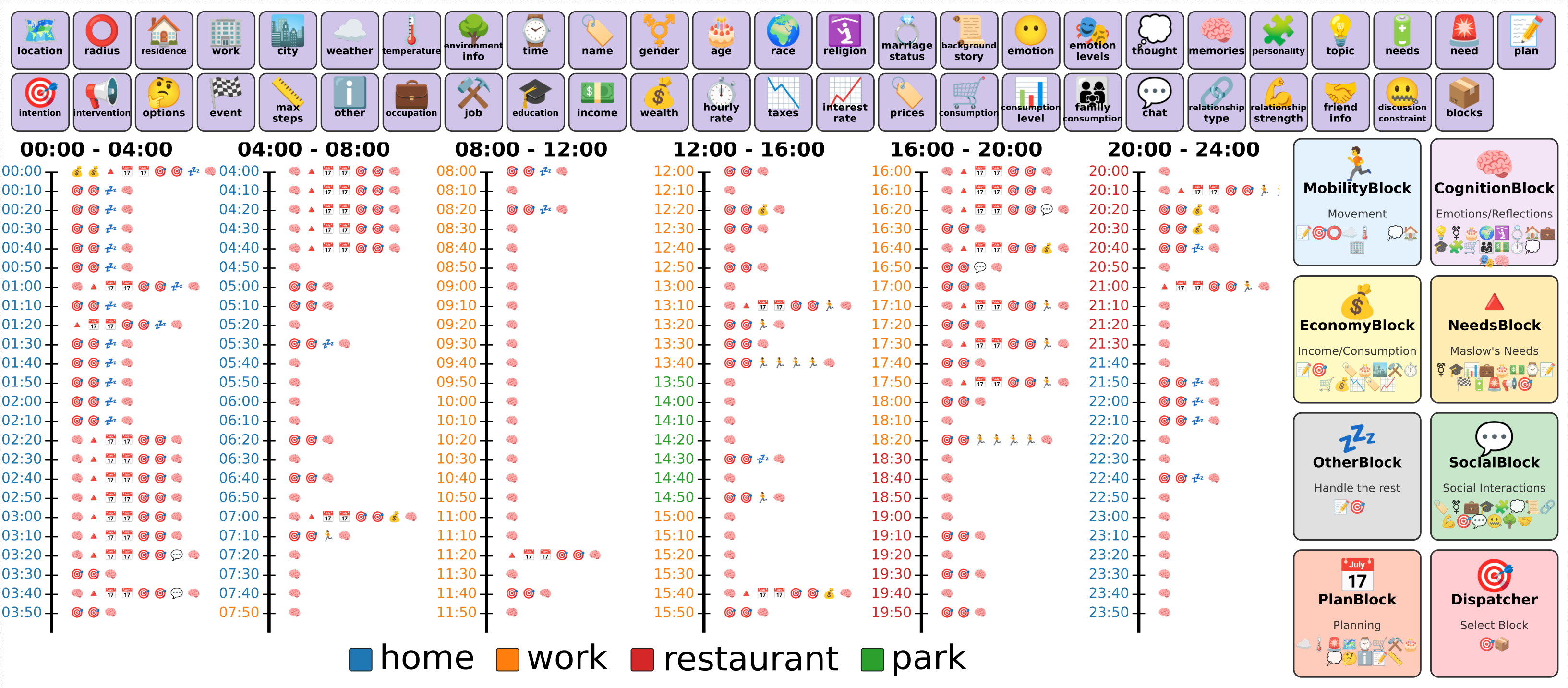
The observability stack maps a simulated daily mobility routine into high-level modules and a timestamped 10-minute workflow. In the web UI, each workflow icon opens the prompt-response pair for that timestamp, making the agent's LLM interactions directly debuggable.
What it adds
Inspect prompts, responses, memories, agent states, trajectories, latency, and token usage throughout a run.
Export trajectories and semantic visits for comparison with empirical datasets, mobility laws, motifs, OD matrices, and activity distributions.
Persist agent memory, messages, mobility state, and simulator state so interrupted experiments restart safely.
Combine CitySim-style behavioral modules, traffic simulation, scalable maps, and flexible DuckDB or ClickHouse storage.
Get started
En-AgentSociety requires Python 3.11 or newer. Start with the example configuration, then inspect the results in the web UI.
$ git clone https://github.com/gefgu/en-agentsociety.git
$ cd en-agentsociety
$ pip install -e packages/en-agentsociety
$ en-agentsociety check -c config.yaml
$ en-agentsociety run -c config.yaml
$ en-agentsociety ui -c config.yaml